
City of Boulder Ballot Issue 2E (2022)
Yes / For the Measure. Boulder’s local elections are currently held in off-years, when many fewer people vote than in even years.

Change Regular Municipal Election to Even Years
Shall Sections 5, 14, and 22 of the Boulder Home Rule Charter be amended to change the regular municipal election date to even numbered years on the same date as the state general election beginning with the November 2026 election date, and to implement the transition, reduce the term of the council members elected in 2023 and 2025 to three years and increase the term of the mayor elected in 2023 to three years, all as more specifically provided in Ordinance 8546?
Yes / For the Measure. Full disclosure: I’m a co-lead on the People for Voter Turnout campaign to pass Boulder Ballot Question 2E. As a former Boulder City Council candidate in 2017 and organizer on many local campaigns, increasing turnout and representation in our city elections is incredibly important to me.
Boulder’s local elections are currently held in off-years, when many fewer people vote than in even years. We have lots of evidence that off-year elections are not only correlated with low voter turnout, but the main cause of low turnout. From the People for Voter Turnout Research Page:

So what happens when voter turnout is low, and why is it a problem? City councils make lots of important decisions affecting our quality of life, including those around housing, services, and policies for our city. When our elections are not representative in terms of age, race, income, housing status, and other factors, our city leaders do not reflect the breadth of people in our community.
Measure 2E would move Boulder’s local elections to even years when nearly double the people are voting. A number of cities across the United States have moved to on-cycle elections and shown dramatic increases in people participating in their local democracy.
Measure 2E was put on the ballot by Boulder City Council after prioritizing the change in January of 2022. I would love your support in making this change here in Boulder.
But not everyone in Boulder thinks the move would be helpful. I want to highlight some comments from local elected officials who openly dismissed the intelligence of voters in Boulder:
Boulder City Councilman Bob Yates, in his July Newsletter: “Maybe the motive here really is to get more people to vote in city council elections, under the belief that quantity is better than quality. Maybe the proponents sincerely believe that voters who currently opt out of odd-year city council elections will, once presented with a council race in even years, become informed about local issues and make good choices.”
Boulder County Commissioner Claire Levy, on October 18th: “Most people I talk to can’t distinguish one candidate from another and dislike the rancorous tone of the outside groups that endorse candidates. It is very difficult to truly understand the differences among the candidates without attending debates and talking to them. Students are here temporarily and don’t see themselves as being affected by what city council does.”
I find these arguments truly gross, and dismissive of the diversity of people and needs in our community. More people need a voice in our local government, not fewer.
So are there any real arguments to oppose the move, other than keeping Boulder elections our little secret? I’ll address the best ones.
Will even-year elections drown out local issues and candidates?
No. In fact, they will elevate issues, as the elections will happen when nearly 90% of Boulder is voting. Candidates will need to make an effort to reach out to a broader set of people in the community and engage people with issues. Here’s a quote from my friend Adrian Fine:
“Palo Alto moved to even-year elections in 2012. When I ran for City Council in 2016, there was no question that an even year meant more people were listening and engaging on local issues.”
-Former Mayor of Palo Alto and current Boulder resident
Will school board elections be ‘orphaned’ if we move city elections?
No. I’ll reference the People for Voter Turnout FAQ:
Boulder’s school board elections occur in off-years like our city council elections currently do, causing them to have very low turnout of around 30%. Like cities, school boards need the autonomy to move their elections to even years to boost turnout and representation. We support and are working to change state law to allow for school board elections to be held in even years.
In the meantime, will turnout drop in school board elections if city council elections move to even years? We have lots of evidence that says no:Only about ⅔’s of people in Boulder who vote in off-years vote in school board elections. These are very consistent voters that vote every year and will continue to vote every year.
Here is some data from the 2021 school board elections in precincts in the City of Boulder to show just how consistent off-year voters are. The table below correlates votes for candidates and undervotes (i.e. vote for none) with voters’ history.
8×8 voters, those who have voted eight times in the past eight elections, are much more likely to vote for school board candidates rather than undervote. On the less-likely voter side, voters who hadn’t voted in an off-year election were much more likely to not vote in school board elections. Even if turnout dropped slightly in future off-years, it will be minor, because the consistent voters have and will continue voting in school board elections.

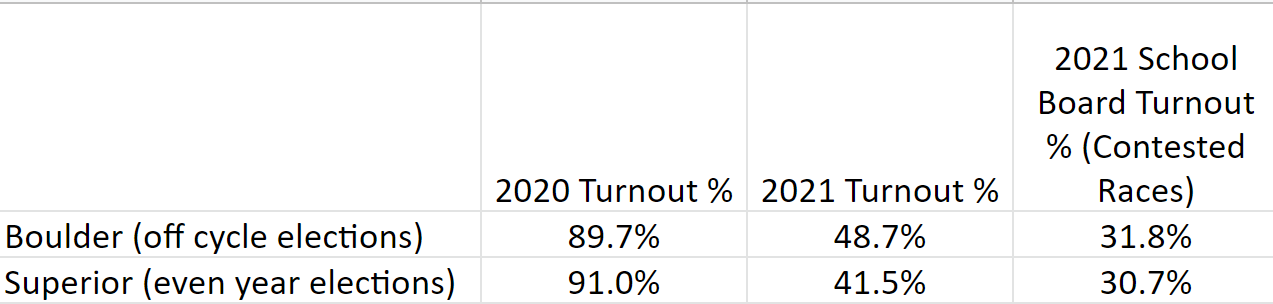
Superior, Colorado — just outside of Boulder and in Boulder Valley School District (BVSD) — holds its municipal city council elections in even years. In 2021, Superior showed virtually identical turnout in school board elections (31%) compared to Boulder (32%).
Here is more in depth data in a comparison between Boulder and Superior using data from Boulder County Clerk. Superior has even higher voter turnout in even years, a somewhat larger drop in off-years, yet rates of voting in school board elections are roughly the same.
Passing measure 2E will be a great benefit to Boulder and help support school boards to work toward increasing turnout in their elections.
Why is turnout lower in off years? Why aren’t people voting in off-cycle elections?
When I first wanted to understand the reason to move local elections to even years, I found a really incredible book. The book is called “Timing and Turnout: How Off-Cycle Elections Favor Organized Groups” by Sarah F. Anzia, Associate Professor of Public Policy & Political Science at UC Berkeley.
Dr. Anzia writes, “moving local elections from off-cycle to the same day as presidential elections is three times more effective at increasing turnout than the most effective mode of mobilization—face-to-face canvassing.” As someone who has knocked thousands of doors in local elections over the years, I was really surprised to hear how important on-cycle elections are for turnout.
I’ll reference the People for Voter Turnout FAQ again:
There are lots of reasons as to why voters don’t turn out as much for odd-year elections.
The majority of people typically think of “Election Day” as the first Tuesday in November of even-numbered years. In off-years, when there are no statewide elections, many people don’t even realize an election is occurring.
Off-years do not have the same level of support or interest from groups and organizations that try to get out the vote, which reduces turnout.
Advocacy groups and organizations do not put in the same level of time, money, or resources into getting out the vote in off-years, which reduces turnout.
Additionally, off-cycle elections are more likely to reduce turnout for lower-income people and renters, who are more likely to move year to year. While Colorado is an all-mail ballot state, a person that moves in August and does not update their voter registration will not receive their ballot by mail. This adds a significant barrier to voting and that effect is multiplied with the reduced awareness of off-cycle elections.
I believe voting Yes on measure 2E will ensure that more people have a say in our local government and that we elect representatives who will and must govern for the broader community.
You can read more details from Shay Castle at Boulder Beat News: 2E: Change Regular Municipal Election to Even Years.
Additional Reporting, Commentary, and Sources
Ordinance 8546 – Change Regular Municipal Election to Even Years – City of Boulder
Episode 27 Jill Adler Grano, People for Voter Turnout – Sharing Boulder Podcast
Editorial: Increasing turnout must be our priority, ‘yes’ on 2E – Daily Camera
Opinion: Yes on 2E: To broaden democracy, broaden the vote – Boulder Beat
Opinion: No on 2E: Keep the focus on local issues – Boulder Beat
Guest opinion: Brian Keegan: Odd election years are temporal gerrymandering – Daily Camera