
Colorado Proposition HH (STATUTORY) (2023)
YES / FOR. I am voting for Prop HH as a way to increase school funding and to reduce the effects of increased property tax burdens in a way that will be more equitable than a simple property tax cut.

Shall the state reduce property taxes for homes and businesses, including expanding property tax relief for seniors, and backfill counties, water districts, fire districts, ambulance and hospital districts, and other local governments and fund school districts by using a portion of the state surplus up to the proposition HH cap as defined in this measure?
YES / FOR. Prop HH has many components with some pros and cons to weigh, which make developing a single narrative about its effects more difficult. I’ll order the effects from what I see as most impactful and important to least impactful.
The Colorado Blue Book is an essential resource to understand Prop HH, and I will reference their materials heavily. As noted by the Colorado Sun, the state has released a newer economic forecast since the blue book was printed. I will use the blue book for analysis and graphs and note any relevant updates to the data as appropriate. If you want a very long and expansive look into Prop HH, I suggest reading the entire Colorado Sun article as well: Proposition HH: What you need to know about the Colorado property tax relief plan.
Context: why and how is this on the ballot now? The Democratic legislature and Governor voted to place Prop HH on the ballot through bill SB23-303 to address rapidly rising property taxes, constraints on school funding, and to get ahead of conservative-backed measures qualified for the ballot in 2024 that seek to permanently reduce Colorado’s property tax revenue.
When will the effects take place? If passed, Prop HH would affect income and property taxes from tax year 2023 due in 2024, for ten years through 2032 for nearly all of the bill’s effects.
What are the principal effects of Prop HH?
- Reducing immediate property tax rate
- Backfilling property tax revenues local governments and districts from revenue-surplus TABOR refunds
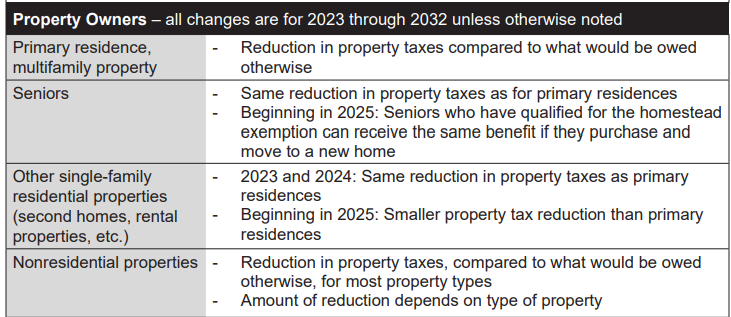
- Expanding property tax relief for seniors
- A 1% per year increase in allowable state budget spending
- The truth-in-taxation provision
- Up to $20 million each year to go toward a state renter relief program
To understand many of the effects of Prop HH, you need to understand TABOR. Here is an excerpt from this year’s Colorado Blue Book:
What is the state’s revenue limit, known as the TABOR limit?
The Colorado Constitution includes a section, “The Taxpayer’s Bill of Rights,” commonly known as TABOR, that limits the amount of money that the state government can collect and spend or save each year. Voter approval is required to retain money above the TABOR limit. If money is collected above the limit, the excess must be refunded to taxpayers. This is called a TABOR refund.
1. Reducing immediate property tax rate
The primary reason for the bill, to reduce a sharply increasing property tax burden, and to help fend off potentially damaging property tax reductions that will be voted on in 2024.
2. Backfilling property tax revenues local governments and districts from revenue-surplus TABOR refunds
To prevent drastic budget cuts to local governments and districts, the measure provides a method to address shortfalls by using TABOR refunds which would otherwise be returned individually to tax filers.
3. Expanding property tax relief for seniors
Extending programs and exemptions for seniors who are often on fixed incomes and are more vulnerable from rising property taxes.
4. A 1% per year increase in allowable state budget spending
A significant portion of benefits from Prop HH come from raising the TABOR cap, which restrains education and other funding in Colorado’s budget.
5. The Limitation on property tax revenue provision
The local property tax revenue provision will cap increases in property tax revenue to the rate of inflation for local governments, with the exception of school districts and “home rule” governments. In the case of Boulder, the city is a home rule government while the county is not. Local governments can override this provision, although most governments will not due so because such overrides would be unpopular.
I don’t love this provision, and would prefer it did not exist. However, it’s much less heavy-handed than the 2024 proposed Property Tax Revenue Cap initiative, which would only let local governments keep property taxes about a cap with the passage of a statewide vote annually.
6. Up to $20 million each year to go toward a state renter relief program
The provision to assist renters in Prop HH is a good one, particularly given the state’s ongoing housing crisis. However, the amount allocated statewide is rather small considering Denver has proposed $15.6 million in rental assistance for 2024 (Denverite).
Beyond the main points, Prop HH has a few other notable effects:
- Starting in 2025, the state will have higher relative tax rates on single-family homes that aren’t a primary residence. For the first two years, all residential properties get a property tax cut. But for the last eight years, non-primary-residence single family homes actually get a lower property tax cut than multifamily / primary home SFH. That would provide a disincentive for investor-owned SFH and second home SFH.
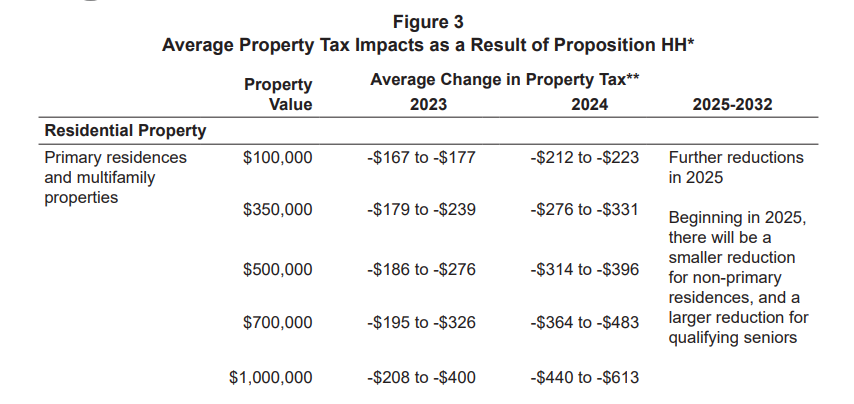
2. The property tax refunds themselves are somewhat progressive (i.e. amount of refund compared to property value). The progressive nature of refunds comes from an exemption on the first $40-50k in property fees. In total, that means properties that are worth less will receive a higher property tax cut.- see graphic
3. 2023 TABOR refunds will be skewed toward lower-income people – see graphic:
For income less than $99,000: TABOR refunds increase; for income greater than $99,000: TABOR refunds decrease.
I would prefer this policy were extended longer / full term, but this is a big deal for next year.
However, the current TABOR refund projections for 2024-2026 are estimated to be 50-75% as large as the 2023 refund. So this one-time policy may have an even more progressive effect happening in 2023 when TABOR refunds are projected to be the largest.

Still unsure about Prop HH? You can see how the measure might affect you personally. Here is a Proposition HH Calculation Tool Maintained by Legislative Council Staff https://hhcalc.apps.coleg.gov/calculators
Additional Reporting, Commentary, and Sources
Colorado Proposition HH, Property Tax Changes and Revenue Change Measure (2023) – Ballotpedia
Why are TABOR refunds so huge lately? And will they stay that way? – CPR News
Proposition HH: What you need to know about the Colorado property tax relief plan – Colorado Sun
Property tax measure cleared for November ballot with Supreme Court opinion – Colorado Newsline
A statewide cap on property taxes will be on the 2024 ballot – CPR News